Our Sustainability Approach
Determining What Matters
GRI 2021: 3-1, 3-2, 3-3 | IFRS S1
Adopting to Changing Contexts
We have always prioritized understanding our most significant impacts, which has been instrumental in shaping our goals and strategies.
Every two years, we conduct a materiality assessment to identify what matters most to our stakeholders and address their evolving expectations. This process also allows us to assess our position as an organization by evaluating our risks and opportunities. Through our materiality assessment, we account for and respond to the changes in the social, economic, and business landscapes that influence what stakeholders consider critical.
Our materiality process aligns with the Global Reporting Initiative (GRI) standards and incorporates the top company risks identified through the Enterprise Risk Management (ERM) system.
This year, in response to the increasing prominence of sustainability issues for businesses and the changing global and local sustainability reporting frameworks, such as that of IFRS S1 and S2, we have transitioned to a Double Materiality Assessment Process.
The double materiality assessment methodology is designed to identify and understand the relative importance of specific ESG and sustainability topics to the business and their stakeholders.
It considers two aspects of sustainability – Impact Materiality and Financial Materiality.
Impact materiality focuses on the actual or potential effects of Manila Water’s activities on stakeholder, the environment, and broader society in the short term and long term.
Financial Materiality focuses on the actual or potential impact that environmental, social, governance, and sustainability issues may have on Manila Water in the short to long-term.


Double Materiality Assessment Process
Identify Potential Material Topics through a Systematic Process
- Considered the broader organizational context, including purpose, vision, mission, core processes, and activities within the Value Creation Framework.
- Conducted a thorough review of the previous materiality assessment and analyzed the latest company risks, considering internal and external environmental shifts.
- With an independent materiality facilitator, performed desktop research to identify and rank potential material topics from over 300 issues, distilling them to 16 key topics.
- Ensured comprehensive stakeholder engagement by consulting seven key stakeholder groups through surveys and interviews to rank material topics and determine financial and impact materiality.
Evaluate Results through a Risk and Opportunity Lens to Prioritize Material Issues
- Evaluated results using a risk and opportunities framework, assessing stakeholder perceptions based on impact and financial materiality, considering criteria such as scale, scope, likelihood, and irremediability.
- Derived thematic insights to refine decision-making for prioritizing material topics.
- Conducted two levels of validation workshops: one with managers from Sustainability, Enterprise Risk Management, and Finance, and another with the Senior Leadership Team, including C-level executives.
- Presented findings of the double materiality assessment at the ESG Committee meeting on December 6, 2024, where committee directors reviewed and concurred on the outcome.
Integrate Material Topics with Strategic Priorities for Actionable Results
- Aim to integrate key material issues into our corporate strategy, aligning with ESG goals and targets for meaningful impact.
- Commit to resolving and continuously monitoring progress on material topics, with clear accountability assigned to functional managers and key executives.
- Maintain regular communication with the CAO, President and CEO, and the ESG Committee to ensure updates on progress, address emerging issues, and refine our approach as necessary.
Scope, Limitations and Boundaries:
A consultant specializing in double materiality assessments conducted our 2024 assessment. The methodology, including parameters such as the number of survey respondents and data gathering tool, was determined by their established double materiality process.
Material Topics
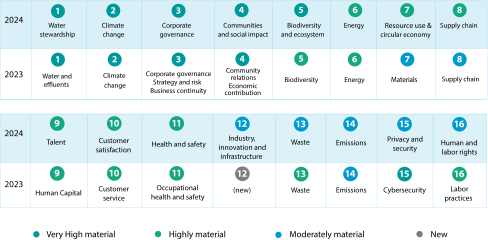
The double materiality assessment exercise yielded 16 material topics, critical to our business and our environmental, social, and governance performance. We intend to continue monitoring and managing our socio-environmental impacts by ensuring these topics are strategically integrated in the way we operate and do business.
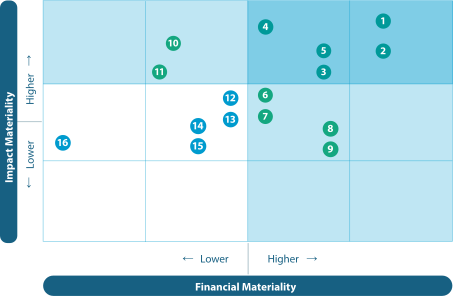
Mapping and comparative between 2024 and 2023 Material Topics
HELPING COMMUNITIES THRIVE
Material Topics
Water Stewardship
Climate Change
Communities and Social Impact
Customer Satisfaction
Industry, Innovation and
Infrastructure
Related Top Risks
Water Supply, CAPEX Delivery,
Commercial, Government/
Regulatory
Related SDGs
To fulfill the mission of serving the communities with water and wastewater services, we strategically leverage our financial, manufactured, social and intellectual capital to treat and distribute clean and potable water to our customers’ taps.
While all these resources directly generate revenues, business prospers as the communities and their local economy thrives. We reinvest these gains back into the business, nature, and the communities, ensuring a sustainable ecosystem between nature, humanity and the built environment.
Water Security. We enhance the security and resilience of our water services through a multi-pronged approach. That includes actively engaging with government and key stakeholders for the development of new and existing water sources, crafting a comprehensive masterplan such as the 4-Water System Masterplan for the East Zone business to guide our long-term strategy, and investing on the critical infrastructure and programs outlined in these plans to ensure a robust and sustainable water supply.
Climate Resilience. We proactively address the potential impacts of climate change and other natural events by incorporating robust risk management strategies into our operations. This includes a comprehensive business continuity plan that emphasizes organizational preparedness and response, alongside the design and development of resilient assets.
Water and Wastewater Service. We prioritize meeting our customers’ evolving water needs and extending access to our services to underserved communities. We achieve this through robust asset management, network improvements, and operational efficiencies, ensuring a sustainable and reliable water supply and wastewater services for all.
Customer Centricity. Our core value of malasakit (care) drives us to deliver exceptional customer service. As a Filipino company, we approach our work with genuine compassion
- Fuel growth opportunities in new markets and underserved communities, leveraging depth of experience in the sector and intellectual capital within and outside the country. (MT) (LT)
- Strengthen partnerships with government agencies, regulators, and key stakeholders to continue to contribute to national development and advance the achievement of the Sustainable Development Goals (SDGs), with a particular focus on SDG 6: Clean Water and Sanitation (ST) (MT) (LT)
PROTECTING THE ENVIRONMENT
Material Topics
Water Stewardship
Climate Change
Biodiversity and ecosystem
Energy
Resource use and circular economy
Industry, Innovation and Infrastructure
Waste
Emissions
Related Top Risks
Water Supply, Commercial,
Government/ Regulatory/
Related SDGs
The state of nature and the environment plays a critical role in creating value for our business. Our primary resource, natural capital – raw water from surface or ground water sources, can vary in terms of quality, quantity, and availability. This variability directly impacts our ability to supply 24/7 water to the communities we serve, both now and in the long term.
Furthermore, the interconnectedness of nature to our business, including our manufactured and financial capital, highlights the importance of a healthy environment for our long-term success. By providing environmental services in the form of wastewater treatment, we are not only fulfilling our environmental responsibility but also re-investing in the natural capital of the communities and the country.
Resource Management. We operate with the mindset that the resources we use from the earth are not finite and that nature needs time to replenish itself. As such, we make use of resources efficiently and adopt circular practices where we can.
Wastewater Management. We protect water bodies and promote a healthier environment by effectively treating wastewater to meet national effluent quality standards, building capacity and infrastructure, and educating customers on responsible wastewater management.
Waste Management. While waste is a by-product of our operations, we ensure not only its safe and responsible disposal to minimize environmental impact, but also explore recycling and circular practices.
Energy Management. In Manila Water, energy management involves efforts from strategically planning sources, energy demand management and conservation and efficiency efforts. Furthermore, it extends to initiatives to manage environmental impact via transition to renewable energy while maintaining operational performance.
Climate Change Mitigation. Despite hurdles, we are actively transitioning to renewable energy sources to balance expanding water and wastewater services with our commitment to reducing our carbon footprint and GHG emissions, contributive to climate change mitigation.
Watershed Management. We recognize our reliance on natural resources and collaborate with stakeholders to implement watershed management programs around our water sources. These initiatives include reforestation, partnerships with indigenous communities, and biodiversity protection.
- Drive operational excellence through continuous innovation and exploration of new technologies, focused on enhancing efficiency, reducing GHG emissions, minimizing waste, and optimizing resource utilization. (ST) (MT) (LT)
- Leverage our strong culture of environmental advocacy and volunteerism to mobilize employee engagement and drive collective action towards achieving our nature and climate goals. (ST) (MT)
- Advance water reuse initiatives to augment water supply and promote circularity. (ST) (MT) (LT)
BUILDING A CULTURE OF TRUST AND CARE
Material Topics
Corporate governance
Supply chain
Talent
Health and safety
Privacy and security
Human and labor rights
Related Top Risks
Government/ Regulatory,
Talent management,
Vendor management,
Systems and processes,
IT-Cybersecurity
Related SDGs
We recognize that our human capital, intellectual capital, and strong social and relationship capital are the cornerstones of our value creation strategy. By strategically investing in and nurturing these critical assets through targeted programs and initiatives, while adhering to strong principles of corporate governance, we empower our people, foster innovation, and strengthen our relationships with stakeholders. This holistic approach drives our business outcomes and sustainable long-term growth for all stakeholders.
Human Capital. At Manila Water, our success hinges on the strength and growth of our people, the Katubigs. We prioritize empowering, engaging, and equipping our talent with the necessary competencies to excel in their careers and contribute significantly to our competitive advantage.
Occupational Health and Safety. Prioritizing the well-being of our people is paramount. We have re-launched our health and safety program as we strive to create a safe and conducive work environment across all our operations, whether in offices, facilities, or project sites.
Governance and Compliance. Strong governance and compliance are foundational to our leadership in the water sector. This includes robust governance structures, policies, and management practices that ensure accountability, transparency, and ethical conduct.
Partnerships. No single entity can navigate the increasingly complex and interconnected challenges in the water industry alone. Collaboration and strong partnerships with government, community, suppliers, and other stakeholders are key to ensure our long term sustainability.
- Future-fit the organization and talents, mindful of the leadership and technical skills needed to thrive amidst an evolving work landscape. (ST) (MT)
- Set targets on health and safety to reinforce the program across all levels of the organization. (ST)
- Continue to leverage strong and mutually beneficial partnerships to unlock opportunities for growth and shared value creation. (ST) (MT) (LT)
Legend:
(ST) Short Term
(MT) Medium Term
(LT) Long Term