
Our Business Review
Corporate Governance
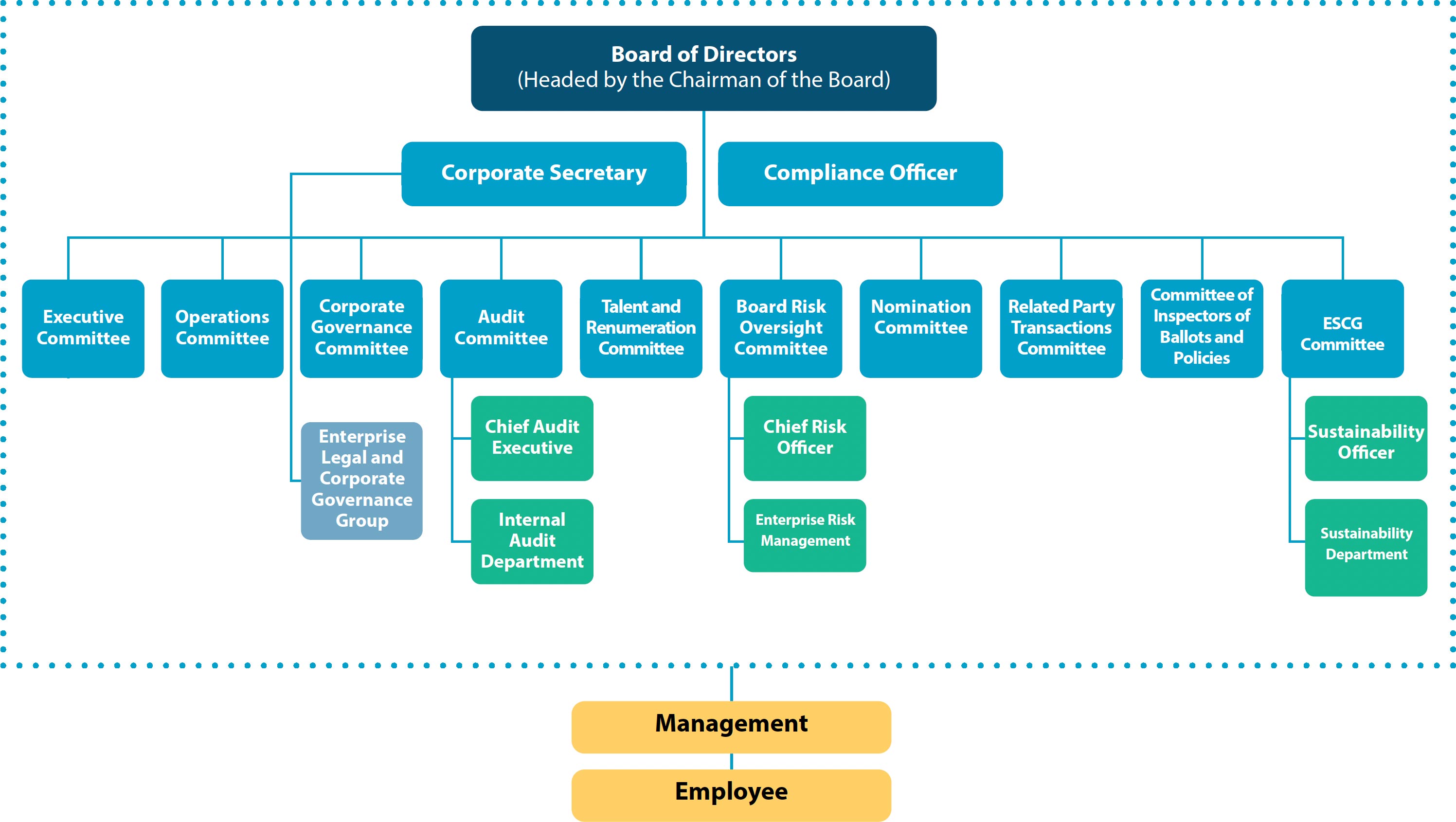
Overall Governance Structure
Manila Water is dedicated to observing the highest standards of corporate governance to serve the best interests of the investing public. The Board, the Management and the employees of the Company are one in the conviction that sound and effective governance is fundamental to the Company’s continued success and stability and will enable it to create and sustain increased value for its shareholders. Maintaining this strong foundation of good governance becomes more essential as Manila Water grows, both in its existing space and in the new markets it enters.
Compliance with Leading Practices On Corporate Governance
Board of Directors
The Company prides itself with its Board of Directors (the "Board"), composed of highly competent individuals with a collective working knowledge, experience or expertise that is relevant to the Company’s industry or sector. The Board provides a clear vision towards the formulation of sound corporate strategies, and oversees the systemization, improvement and upholding of transparency in governance. The Board provides guidance in achieving fairness and accountability in all major dealings of the Company, with the objective of protecting the interests of its stakeholders. In this connection, the Board fulfills certain key functions, including: reviewing and guiding corporate strategy, major plans of action, risk policy, annual budgets and business plans, setting performance objectives, monitoring implementation and corporate performance, and overseeing and approving major capital expenditures, acquisitions and divestitures, monitoring the effectiveness of our governance practices and making changes as needed, selecting, compensating, monitoring and, when necessary, replacing key executives and overseeing succession planning, aligning key executive and board remuneration with the longer term interests of the Company and its stakeholders, ensuring a formal and transparent board nomination and election process, and monitoring and managing potential conflicts of interest of management, board members, stockholders and stakeholders, including misuse of corporate assets and abuse in related party transactions.
Board Composition
The Board has eleven (11) members who are elected by the stockholders during the annual stockholders’ meeting ("ASM"). The Board should have at least three (3) independent directors, or such number as to constitute at least one-third of the member of the Board, whichever is higher. All nominations to the Board are undertaken in accordance with the Manual of Corporate Governance (the "Manual"), By-laws, the Charter of the Board, and the existing rules and regulations. Upon receipt of all nominations, the Nomination Committee convenes to evaluate the qualifications of nominees for election to the Board. In evaluating the nominations, the Nomination Committee adheres to the criteria for selection and the qualifications and disqualifications of directors set forth in the Manual, the Charter of the Board, the Charter of the Board Committees, the Securities Regulations Code (SRC), and those under existing laws, rules, and regulations. After deliberation, the Nomination Committee and the Board issue a resolution endorsing the election of the qualified nominees at the Annual Stockholders’ Meeting (ASM). The members of the Board so elected at the ASM hold office for one (1) year, and until their successors have been elected and qualified in accordance with the By-laws. The elected members of the Board are mandated to oversee the management of the Company, and, in the performance of their duties, must exercise their best and unbiased judgment to protect and promote the interest of the Company and its stakeholders. The inputs and opinions of each Director are valued; it is ensured that a Director shall not be discriminated upon by reason of gender, age, ethnicity, political, religious, or cultural beliefs. Towards this end, the Board has adopted a policy of diversity in gender, age, and ethnicity, as well as religious, political, or cultural background. Through this policy, the Board encourages the stockholders to nominate and select individuals who will promote diversity in the membership of the Board.
Independent Directors
In compliance with the requirements of the law, the Company’s Manual, and the rules and regulations of the SEC, the Company has four (4) independent directors as members of the Board. Under the Manual, a director is considered independent if he or she holds no interests or relationships with the Company that may hinder his or her independence from the Company or its Management which would interfere with the exercise of independent judgment in fulfilling the responsibilities of a director. The Company also subscribes to the requirements of independence under existing laws, rules, and regulations. As required in our legislative franchise under Republic Act No. 11601, an Independent Director shall have at least 3 years of management or supervisory experience in the professional fields of water security, water science policy and management, environmental science, or any similar field. Furthermore, we ensure that our independent directors have all the qualifications and none of the disqualifications specified in SEC Memorandum Circular No. 16 Series of 2002. As required in the legislative franchise of the Company under Republic Act No. 11601, an Independent Director shall have at least three (3) years of management or supervisory experience in the professional fields of water security, water science policy and management, environmental science, or any similar field. Furthermore, we ensure that our independent directors have all the qualifications and none of the disqualifications specified in SEC Memorandum Circular No. 16 Series of 2002.
1 Ms. Sherisa P. Nuesa, Mr. Cesar A. Buenaventura, Mr. Octavio Victor R. Espiritu, and Mr. Eric Ramon O. Recto are the incumbent independent directors of the Company.
Board Committees
The Board is supported by several committees, namely: Executive Committee, Audit Committee, Corporate Governance Committee, Board Risk Oversight Committee, ESG Committee, Related Party Transactions Committee, Nomination Committee, and the Talent and Remuneration Committee. These Board Committees are required to report to the Board a summary of the actions taken on matters submitted to them for consideration at subsequent meetings of the Board. Each of the Board Committees has its own charter that provides guidance on the manner by which its members and the committees should exercise their functions and mandates.
The Executive Committee
The Executive Committee of the Company is composed of five (5) directors, with one (1) member as Chairman of the Executive Committee. The Executive Committee acts by majority vote of all its members and is authorized to act and shall act on matters within the competence of the Board, except those with respect to:
- a. the approval of any action for which stockholders’ approval is also required;
- b. the filling of vacancies in the Board;
- c. the amendment or repeal of the By-laws or the adoption of new By-laws;
- d. the amendment or repeal of any resolution of the Board, which by its express terms is not so amendable or repealable;
- e. the distribution of cash dividends to stockholders;
- f. the exercise of powers delegated by the Board exclusively to other committees, if any.
The Executive Committee meets as needed and performs such other functions as may be properly delegated to it by the Board. The Executive Committee did not hold a meeting in 2024.
The Audit Committee
majority of whom are independent directors, and is chaired by an independent director.2
The Audit Committee is expected to support the corporate governance process through the provision of checks and balances, which are expected to bring positive results in supervising and supporting the management of the Company. It is responsible for ensuring the development of, compliance with, and periodic review of financial reporting policies and practices of the Company. The Audit Committee also oversees the activities of Internal Audit. Moreover, the Audit Committee also recommends and/or concurs to the appointment, replacement, re-assignment and removal or dismissal of the Chief Audit Executive to ensure that the external and internal auditors will function and operate independently of the management as required of their function.
2 In accordance with Part C of the Charter of the Audit Committee, the Committee shall be composed of at least three (3) non-executive directors as members, majority of whom shall be independent directors, and shall be chaired by an independent director.
| Executive Committee | Audit Committee | Board Risk Oversight Committee | Environment, Social, and Governance Committee | Corporate Governance Committee | Related Party Transactions Committee | Nomination Committee | Talent and Renumeration Committee |
|---|---|---|---|---|---|---|---|
Enrique K. Razon, Jr. (Chairperson) | |||||||
Jose Victor Emmanuel A. De Dios (Member) | Jose Victor Emmanuel A. De Dios (Chairperson) | Jose Victor Emmanuel A. De Dios (Member) | |||||
Donato C. Almeda (Member) | Donato C. Almeda (Member) | Donato C. Almeda (Member) | |||||
Sandy A. Alipio (Member) | Sandy A. Alipio (Member) | Sandy A. Alipio (Member) | |||||
Sherisa P. Nuesa (Chairperson) | Sherisa P. Nuesa (Member) | Sherisa P. Nuesa (Member) | Sherisa P. Nuesa (Member) | Sherisa P. Nuesa (Member) | |||
Cesar A. Buenaventura (Member) | Cesar A. Buenaventura (Chairperson) | Cesar A. Buenaventura (Member) | Cesar A. Buenaventura (Member) | Cesar A. Buenaventura (Member) | Cesar A. Buenaventura (Member) | ||
Octavio Victor R. Espiritu (Member) | Octavio Victor R. Espiritu (Member) | Octavio Victor R. Espiritu (Member) | Octavio Victor R. Espiritu (Member) | Octavio Victor R. Espiritu (Chairperson) | Octavio Victor R. Espiritu (Chairperson) | ||
Eric Ramon O. Recto (Member) | Eric Ramon O. Recto (Member) | Eric Ramon O. Recto (Member) | Eric Ramon O. Recto (Member) | Eric Ramon O. Recto (Chairperson) | Eric Ramon O. Recto (Member) |
All members of the Audit Committee are required to possess adequate understanding of accounting and auditing principles in general and of the Company’s financial management systems and environment, in particular. Ms. Sherisa P. Nuesa, the Lead Independent Director and Chairperson of the Audit Committee, is a Certified Public Accountant. The Audit Committee meets at least every quarter and before the quarterly Board meetings and when needed.
On June 3, 2021, the Charter of the Audit Committee was amended to reduce the minimum number of non-executive directors who may be elected as members of the Committee. On November 9, 2021, the Audit Committee approved and the revision to their charter to include the Audit Committee’s responsibility in assessing the independence, adequacy of resources, professional qualifications, and competence of the external auditor and ensuring that the rotation or change of external auditors and key engagement partners is in accordance with the requirements prescribed by applicable laws and regulations and that the required disclosure will be made in case of resignation, dismissal, or cessation from service of the external auditor. Moreover, the rules and procedures governing the Audit Committee in the conduct of its meetings and the Audit Committee remuneration is also included in this revision. These changes were ratified by the Board of Directors on November 18, 2021.
The Committee held four (4) regular meetings and one (1) special meeting in 2024.
| Audit Committee | Meetings Attended/Held |
|---|---|
Sherisa P. Nuesa | 5/5 |
Octavio Victor R. Espiritu | 5/5 |
Cesar A. Buenaventura | 5/5 |
Sandy A. Alipio5 | 5/5 |
The Corporate Governance Committee
The Corporate Governance (CG) Committee is composed of four (4) independent directors including the Chairman3. The CG Committee is tasked with ensuring compliance with and proper observance of corporate governance principles and practices duties and functions include, among others functions as may be delegated by the Board from time to time:
- Oversees the implementation of the corporate governance framework and periodically reviews the said framework to ensure that it remains appropriate in light of material changes to the Company’s size, complexity, and business strategy, as well as its business and regulatory environments;
- Oversees the periodic performance evaluation of the Board and its committees as well as executive management, and conducts an annual self-evaluation of its performance;
- Ensures that the results of the Board evaluation are shared, discussed, and that concrete action plans are developed and implemented to address the identified areas for improvement;
- Develops and recommends continuing education and training programs for directors, and assignment of tasks/projects to Board committees;
On June 3, 2021, the Board of Directors approved the proposal to amend the required number of directors from three (3) to as least three (3) members, all of whom shall be independent directors.
The Chief Compliance Officer, in coordination with the Corporate Secretary, shall support the Committee in the performance of its functions. The Corporate Governance Committee held one (1) meeting in 2024.
| Governance Committee | Meetings Attended/Held |
|---|---|
Octavio Victor R. Espiritu | 1/1 |
Cesar A. Buenaventura | 1/1 |
Eric Ramon O. Recto | 1/1 |
Sherisa P. Nuesa | 1/1 |
The Board Risk Oversight Committee
The Board Risk Oversight Committee (BROC) is composed of four (4) members, majority of whom are independent directors, and is chaired by an independent director4. In accordance with the BROC charter, Mr. Buenaventura, who chairs the Committee, does not sit as the chairman of the Board or of any other committee. The Board Risk Oversight Committee was established separately from the Audit Committee in order to further enhance governance on risk matters and align with the best practices in risk management and supported by the Enterprise Risk Management Department in the performance of its functions.
This committee is tasked to provide assistance in fulfilling the Board’s oversight responsibilities in relation to risk governance in Manila Water, which includes ensuring that the Management maintains a sound and responsive risk management system across the organization; promote an open discussion regarding risks faced by the Company, as well as risks faced by its subsidiaries that may have potential impact on the Company’s operations, and ensure that risk awareness culture is pervasive throughout the organization.
On February 11, 2021, the Charter of the Board Risk Oversight Committee was amended to add additional roles and responsibilities and further define its governance and oversight function. The amendment was ratified by the Board of Directors during their meeting on February 24, 2021.
On June 3, 2021, the Board of Directors approved the proposal to amend the required number of members of the Committee from four (4) to at least three (3), majority of whom shall be independent directors of the Company.
The Board Risk Oversight Committee held four (4) meetings in 2024. From the year 2020, the BROC meets every quarter as compared to the semi-annual frequency in previous years.
| Board Risk Oversight Committee | Meetings Attended/Held |
|---|---|
Cesar A. Buenaventura | 4/4 |
Sherisa P. Nuesa | 4/4 |
Eric Ramon O. Recto | 4/4 |
Donato C. Almeda | 4/4 |
The Related Party Transactions Committee
The Related Party Transactions Committee (RPT) Committee is composed of four (4) non-executive directors5, majority of whom are independent directors . In accordance with the RPT Committee Charter, Mr. Recto, who is an independent director, is the Chairman of the Committee.
This committee is primarily tasked with the duty of enforcing and implementing the Related Party Transactions Policy of the Company. The Committee also ensures that material RPT shall have terms and conditions that are fair and equitable to the Company; the approval, award, processing and payment of RPT shall follow the same procedures as the other transactions and contracts of the Company, and therefore, no unusual privilege or special treatment shall be afforded a Related Party; and in case of doubt on the nature of a transaction subject of investigation or review pursuant to the RPT Policy, the Office of the Compliance Officer, in consultation with the RPT Committee, shall determine whether the transaction or relationship constitutes a RPT, and whether the same shall be pursued taking into consideration the cost and benefit to the Company.
On October 28, 2019, the Related Party Transactions Committee approved the amendments to the Company’s Policy on Related Party Transactions in order to comply with the provisions of the Rules on Material Party Transactions for Publicly Listed Companies of the SEC. The amendments to the Company’s Policy were ratified by the Board of Directors during its Regular Meeting on November 26, 2019.
TOn June 3, 2021, the Charter of the RPT Committee was amended to reduce the minimum number of committee members from four (4) to at least three (3), and at least two (2) members shall be independent directors of the Company.
The RPT Committee held three (3) meetings in 2024.
| Related Party Transactions Committee | Meetings Attended/Held |
|---|---|
Eric Ramon O. Recto | 3/3 |
Octavio Victor R. Espiritu | 3/3 |
Cesar A. Buenaventura | 3/3 |
Sandy A. Alipio | 3/3 |
The Nomination Committee
The Nomination Committee is composed of at least three (3) directors, majority of whom are independent directors, and under its Charter is required to be chaired by an independent director6 .
This committee is tasked to install and maintain an evaluation process to ensure that all directors to be nominated to the Board during the annual stockholders’ meeting have all the qualifications and none of the disqualifications stated in the Manual, the Charter of the Board and the Committees, and under existing laws and regulations undertakes the process of identifying the quality of directors consistent with the Company’s strategic directions, and to ensure that the directors have the competence and professional background that will enable them to perform their duties as directors of Manila Water.
The Nomination Committee is also responsible for evaluating the qualifications of all officers nominated to positions in the Company which are appointed, or required to be appointed, by the Board and provides guidance and advice as necessary for the appointment of persons nominated to other positions. It also reviews and revises, if necessary, the succession plans for members of the Board and officers with ranks from Group Directors to the President and CEO.
The Nomination Committee met four (4) times in 2024.
| Nomination Committee | Meetings Attended/Held |
|---|---|
Octavio Victor R. Espiritu | 4/4 |
Sherisa P. Nuesa | 4/4 |
Cesar A. Buenaventura | 4/4 |
Donato C. Almeda | 4/4 |
4 Section 1.1 of the Charter of the Related Party Transactions Committee states that the Committee shall be composed of at least three (3) non-executive directors as members, two (2) of whom shall be independent.
5 Section 1.1 of the Charter of the Related Party Transactions Committee states that the Committee shall be composed of at least three (3) non-executive directors as members, two (2) of whom shall be independent.
The Talent and Remuneration Committee
The Talent and Remuneration Committee is composed of four (4) members, and in accordance with its Charter, is chaired by an independent director7.
As of December 31, 2023, two (2) of the Company’s independent directors serve as members of the Committee.
The Committee is tasked with the duty to determine and approve all matters and policies relating to the remuneration and benefits of the Company’s directors and key officers; to establish a formal and transparent procedure for developing a policy on remuneration of directors and officers to ensure that their compensation is consistent with the Company’s culture, strategy and the business environment in which it operates; to determine and approve all matters relating to the
remuneration and benefits of the Board and the Company’s officers; to evaluate and recommend for Board approval the pertinent guidelines on executive compensation, including non-monetary remuneration; and to periodically review and evaluate the policy on remuneration in order that it be in a sufficient level to attract and retain directors and officers of the Company.
On November 14, 2019, the Talent and Remuneration Committee approved the addition of the following in its scope of powers, duties, and responsibilities: a) total rewards, merit increases, salary, and retirement and benefits plan, b) senior management and executive promotions, c) overall succession landscape, d) tracking of key talents, e) talent management and risk updates. The amendments were ratified by the Board of Directors during its regular meeting held on November 26, 2019.
On June 3, 2021, the Talent and Remuneration Committee Charter was amended, removing the requirement that majority of the members of the Committee are independent directors.
The Talent and Remuneration Committee held one (1) meeting in 2024.
| Talent and Remuneration Committee | Meetings Attended/Held |
|---|---|
Octavio Victor R. Espiritu | 1/1 |
Eric Ramon O. Recto | 1/1 |
Antonio T. Aquino | 1/1 |
Jose Victor Emmanuel A. de Dios | 1/1 |
The Environment, Social, and Governance Committee
The Board of Directors established the ESG Committee on February 24, 2022 to accord focus on the integration of economic, environmental, social and governance (EESG) principles in the formulation and implementation of the Company’s plans and strategies. The Committee is supported by the Sustainability Officer and is composed of five (5) members of the Board, with all independent directors of the Company serving as members. The President and Chief Executive Officer of the Company serves as the Chairman of the Committee. The ESG Committee held three (3) meetings in 2024.
| Environment, Social, and Governance Committee | Meetings Attended/Held |
|---|---|
Jose Victor Emmanuel A. de Dios | 3/3 |
Sherisa P. Nuesa | 3/3 |
Cesar A. Buenaventura | 3/3 |
Octavio Victor R. Espiritu | 3/3 |
Eric Ramon O. Recto | 3/3 |
The Committee of Inspectors of Ballots and Proxies
Membership consists of the Chief Audit Executive as Chairperson, the Assistant Corporate Secretary, and a representative of the external auditor of the Company as members.
Membership consists of the Chief Audit Executive as Chairperson, the Assistant Corporate Secretary, and a representative of the external auditor of the Company as members.
The Committee held one (1) meeting in 2024.
| Committee of Inspectors of Ballots and Proxies | Meetings Attended/Held |
|---|---|
Mailene M. Cabral | 1/1 |
Romelyn A. Obligacion (representing Atty. Ninez C. Maningat) | 1/1 |
Corporate Orientation and Corporate Governance Trainings for Directors
The members of the Board are required to regularly attend seminars and conferences to continuously update themselves on the developments in policy, regulations, and standards on good corporate governance. Under the Company’s Manual, the members of the Board are also provided with such resources, trainings, and continuing education to enable each member to actively, independently, and judiciously participate in Board and Committee meetings.
Newly elected members of the Board undergo orientation programs for them to have a working knowledge of the statutory and regulatory requirements affecting the Company. They are also required to keep abreast with industry developments and business trends in order that they may promote the Company’s competitiveness and sustainability. Attendance in a corporate governance seminar conducted by a duly recognized private or governmental institution is also a mandatory requirement prior to their assumption of office and during their term of office.
The Company also provides general access to training courses to its directors as a matter of continuous professional education as well as to enhance their skills as directors and keep them updated in their knowledge and understanding of the Company’s business. The Board and Board Committees are also allowed to hire independent legal counsel, accountants, or other consultants to advise them when necessary.
At every board meeting, directors are provided with a management update on the operational and financial status of, and other relevant matters, about the Company to ensure that the directors are continuously informed of new developments and the performance of the Company.
Upon assumption of office, a director appointed for the first time undergoes a corporate orientation program conducted by the Office of the Corporate Secretary. The corporate orientation program includes modules on the operations of the Company, as well as relevant contracts of the Company. The orientation also covers existing policies, rules, and regulations of the Company. The curriculum of the orientation program may be revised as often as necessary to include other relevant subjects and matters relating to the Company. In addition to the corporate orientation program for new directors, the Office of the Corporate Secretary informs the Board of any updates on the matters covered by the orientation program. The corporate orientation program and updates are usually given during the regular meetings of the Board.
These programs notwithstanding, Manila Water encourages its directors to attend external trainings, courses or continuing professional education programs on corporate governance. The Directors are required to inform the Office of the Corporate Secretary of the trainings or courses attended for record and disclosure purposes.
Corporate Governance Programs Attended by the Board of Directors in 2024
| Name of Director | Date of Training | Title of Training | Training Provider |
|---|---|---|---|
Enrique K. Razon, Jr. | 15-Nov-2024 | Advanced Corporate Governance Training | Institute of Corporate Directors |
Jose Victor Emmanuel A. de Dios | 15-Nov-2024 | Advanced Corporate Governance Training | Institute of Corporate Directors |
Donato C. Almeda | 15-Nov-2024 | Advanced Corporate Governance Training | Institute of Corporate Directors |
Sandy A. Alipio | 15-Nov-2024 | Advanced Corporate Governance Training | Institute of Corporate Directors |
Katrina Maria S. Razon | 15-Nov-2024 | Advanced Corporate Governance Training | Institute of Corporate Directors |
Sherisa P. Nuesa | 19-Sep-24 | Global Governance Summit "Leading the Future, Strengthening Unity" | Institute of Corporate Directors |
5-Nov-24 | 2024 Ayala Integrated Corporate Governance, Risk Management, and Sustainability Summit | Institute of Corporate Directors | |
Cesar A. Buenaventura | 15-Nov-24 | 2024 Ayala Integrated Corporate Governance, Risk Management, and Sustainability Summit | Institute of Corporate Directors |
Octavio Victor R. Espiritu | 15-Nov-24 | Advanced Corporate Governance Training | Institute of Corporate Directors |
Eric Ramon O. Recto | 15-Nov-24 | Advanced Corporate Governance Training | Institute of Corporate Directors |
26-Nov-24 | 2024 In-House Corporate Governance Seminars (i) AI Optimist; (ii) Conscious Business; (iii) The Hundred-Year Mara- thon; China's Secret Strategy to Replace America as the Global Superpower; (iv) Cyber Crisis-Protecting Your Business from Real Threats in the Virtual Word; and (v) Scary Smart: The Future of Artifi- cial Intelligene | Aboitiz |
Board Meetings
Under the Charter of the Board, the Board institutionalized a policy of holding at least six (6) meetings in a year. These include the organizational meeting of the Board which is held immediately after the annual stockholders’ meeting. Under the By-laws, special meetings may be called by the Chairman, Vice Chairman, President or at the instance of a majority of the members of the Board.
The Board has a policy of requiring the presence of at least one (1) independent director in all its meetings.
Quorum in Board Meetings
Under the By-Laws of the Company, at least two-thirds (2/3) of the members of Board (as fixed in the Articles of Incorporation) shall constitute a quorum for the transaction of corporate business, and every decision of at least a majority of the directors present at a meeting at which there is a quorum shall be valid as a corporate act, except when a higher quorum is required in contracts binding on the Company.
In the absence of a quorum, a majority of the directors present may adjourn any meeting from time to time until a quorum is obtained.
Attendance of Directors in Board Meetings
In 2024, a total of 11 meetings were held by the Board as follows:
| No. | Date | Meeting |
|---|---|---|
1 | February 29, 2024 | Special Asynchronous Meeting of the Board of Directors |
2 | April 5, 2024 | Special Asynchronous Meeting of the Board of Directors |
3 | April 25, 2024 | Organizational Meeting of the Board of Directors |
4 | May 10, 2024 | Special Asynchronous Meeting of the Board of Directors |
5 | May 13, 2024 | Special Asynchronous Meeting of the Board of Directors |
6 | May 16, 2024 | Special Asynchronous Meeting of the Board of Directors |
7 | June 28, 2024 | Special Asynchronous Meeting of the Board of Directors |
8 | July 30, 2024 | Special Asynchronous Meeting of the Board of Directors |
9 | August 8, 2024 | Regular Meeting of the Board of Directors |
10 | November 14, 2024 | Regular Meeting of the Board of Directors |
11 | December 13, 2024 | Special Asynchronous Meeting of the Board of Directors |
The Non-Executive Directors’ (NED) Meeting was held on November 14, 2024.
Mr. Enrique K. Razon, Jr., Mr. Jose Victor Emmanuel A. de Dios, the Company’s President and Chief Executive Director, Mr. Donato C. Almeda, the Company’s Chief Regulatory Officer, and Mr. Sandy Alipio were not a party to the meeting of the Non-Executive Directors.
The attendance of each member of the Board of Directors is listed below:
| Name of Director | Board Meetings Attended | Percentage Present |
|---|---|---|
Mr. Emmanuel S. Buencamino | 11/11 | 100% |
Jose Victor Emmanuel A. de Dios | 11/11 | 100% |
Donato C. Almeda | 11/11 | 100% |
Antonio T. Aquino (Term ended on April 25, 2024) | 2/2 | 100% |
Alberto T. Larrazabal (Resigned as of May 17, 2024) | 6/6 | 100% |
Sandy A. Alipio 14 | 8/8 | 100% |
Katrina Maria S. Razon 15 | 11/11 | 100% |
Sherisa P. Nuesa | 11/11 | 100% |
Cesar A. Buenaventura | 11/11 | 100% |
Octavio Victor R. Espiritu | 11/11 | 100% |
Eric Ramon O. Recto | 11/11 | 100% |
During the 2024 Annual Stockholders’ Meeting (ASM) held on April 25, 2024, and conducted virtually via https://conveneagm.com/ph/MWCI2024ASM, the Chairman of the Board of Directors, President and CEO of the Company, and the Chairman of the Audit Committee along with the other directors and executive officers of the Company, were in attendance. Their attendance was duly recorded in the minutes of the said meeting. The minutes of the ASM may be viewed on our website.
Board Remuneration
The Board determines a level of remuneration for directors that shall be sufficient to attract and retain directors and compensate them for attendance at meetings of the Board and Board Committees and their performance of numerous responsibilities of a Board member. The Talent and Remuneration Committee is responsible for recommending to the Board the fees and other compensation for directors. In fulfilling this duty, the Talent and Remuneration Committee is guided by the objective of ensuring that the proposed fees should fairly compensate the directors for the work required consistent with the Company’s size and industry.
In a special meeting held on April 11, 2011, the Board approved an increase in the Board remuneration. The approved remuneration for each member of the Board consists of Php500,000.00 as a fixed annual retainer fee, Php200,000.00 for each meeting of the Board actually attended, and Php50,000.00 for each Committee meeting actually attended. This Board remuneration structure was approved by the stockholders in its ASM held on April 11, 2011. In the same annual meeting, the stockholders approved the amendment of the By-laws, giving the Board of Directors the authority to determine the amount, form, and structure of the fees and other compensation of the directors.
On November 18, 2021, the Board resolved that Executive Directors shall not receive per diem remuneration for their participation and attendance in the meetings of the Board and Board Committees. On February 24, 2022, the Board approved to discontinue the payment of per diems of directors for their attendance and participation in special meetings of the Board and Board Committees conducted asynchronously.
None of the non-executive and independent directors who are paid fees as set forth above is engaged and compensated by the Company for services other than those provided as a director.
The Company has no other arrangement as regards the remuneration of its existing non-executive and independent directors aside from the compensation received as herein stated.
The directors of the Board received the following gross per diem remuneration for attending the meetings of the Board of Directors, the meeting of the Non-Executive Directors, the annual stockholders’ meeting, and their respective Committee Meetings in 2024:
| Name | 2024 Retainer Fee | Attendance in the Meetings of The Board and Stockholders# | Attendance in the Meetings of the Board Committees | TOTAL |
|---|---|---|---|---|
Enrique K. Razon, Jr. | P375,000 | P1,000,000 | P0.00 | P1,375,000 |
Jose Victor Emmanuel A. de Dios* | - | - | - | - |
Antonio T. Aquino (until April 25, 2024) | - | P200,000 | P50,000 | P250,000 |
Alberto M. De Larrazabal (until May 17, 2024) | P125,000 | P600,000 | - | P725,000 |
Karl Kendrick T. Chua (until May 17, 2024) | P125,000 | P400,000 | - | P525,000 |
Sandy A. Alipio* | - | - | - | - |
Katrina Maria S. Razon | P375,000 | P1,200,000 | - | P1,575,000 |
Sherisa P. Nuesa** | P375,000 | P1,200,000 | P550,000 | P2,125,000 |
Cesar A. Buenaventura** | P375,000 | P1,200,000 | P550,000 | P2,125,000 |
Octavio Victor R. Espiritu** | P375,000 | P1,200,000 | P500,000 | P2,075,000 |
Eric Ramon O. Recto** | P375,000 | P1,200,000 | P400,000 | P1,975,000 |
TOTAL | P2,500,000 | P8,200,000 | P2,050,000 | P12,750,000 |
# Inclusive of the remuneration for the NED Meeting
* As executive directors, Messrs. de Dios, Almeda, and Alipio do not receive remuneration for attending Board and Board Committee Meetings.
** Independent Director
Annual Board Evaluation
The Board has an annual evaluation process that is required to be accomplished by the directors, which enables an informed and objective assessment of the following:
- Board and Board Committee processes and meetings;
- Compliance with the responsibilities and functions of the Board and Board Committees;
- Board-Management relationship;
- Board Member self-evaluation;
- Evaluation of the performance of the President and CEO and Senior Management
This evaluation enables the Board and the Management to determine areas that need improvement on the very scope and criteria of the evaluation process. It also allows the Board to explain their respective ratings and to provide their own comments on the matters discussed in the evaluation. The scope and criteria for the Board Evaluation Process is contained in the Charter of the Board of Directors. The Charter of the Board is available for download at the Company’s website.
In addition to the annual Board evaluation process, the Audit Committee adopted SEC Memorandum Circular No. 4 Series of 2012 on the Guidelines for the Assessment of the Performance of Audit Committees of Companies Listed on the Philippine Stock Exchange which took effect on June 30, 2012. Pursuant to this, an annual evaluation is also being conducted to assess the performance of the Audit Committee.
These annual evaluation processes are facilitated by the Office of the Corporate Secretary in coordination with the Corporate Governance Committee. The Company also engages a third-party evaluator to assess the performance of the Board, the Company’s Chairman, and individual directors every three years or as needed.
To determine and measure the effectiveness of the Board of Directors, the Company is guided by its Manual on Corporate Governance which is available on the Company website: https://www.manilawater.com/corporate-governance/corporate-governance-manual
The Board has conducted an annual self-assessment of its performance, including the performance of its individual members for the year 2024. It has also established an internal self-rating and evaluation system.
For the rating system, rates follow a scale of 1 to 5, 1 being the lowest and 5 being the highest. Questionnaires were provided to each of the Directors wherein they check for each item the rating that corresponds to their personal assessment. An additional portion for comments and/or suggestions is also allotted at the end of the Questionnaire.
Office of the Corporate Secretary
The Corporate Secretary ensures that the Board and the Management follow internal and external rules and regulations and facilitates clear communications between the Board and Management. More importantly, the Company recognizes the mandate of the Office in championing the compliance of the Board and the Company with good corporate governance practices and policies. For this purpose, the Office of the Corporate Secretary, under its Charter, is mandated to coordinate with the Office of the Compliance Officer regarding the formulation and implementation of the corporate governance practices of the Company, especially those relevant to and affecting the Board.
The Management
The Management is primarily responsible in deciding and implementing the day-to-day affairs of the Company.
Management determines the Company’s activities by putting the Company’s targets in concrete terms and by formulating the basic strategies for achieving these targets.
Management is primarily accountable to the Board for the operations of the Company. As part of its accountability, the Management is required to provide the Board with adequate, regular, and timely information on the operations and affairs of the Company.
Reliance on information volunteered by management may not be sufficient in all circumstances and further inquiries may have to be made by a member of the Board of Directors to enable him to properly perform his duties and responsibilities. Hence, the Board should be given independent access to the management, the Chief Compliance Officer, the Risk Officer, the Internal Audit, External Auditor, and the Corporate Secretary.
Succession Planning
The Board, with the assistance of the Remuneration Committee, the Nomination Committee, and the Company’s Corporate Human Resources Group, has adopted a professional development program for employees, officers, and senior management. The succession management process has been an established practice since the early years of Manila Water and over time has been embedded in leadership responsibilities across the organization. It has been a critical enabler of company operations, having enabled succession in key leadership positions and mid management roles across the organization.
Through its robust succession management, the Company has put in place a process to determine the competencies, potential for growth, knowledge, and experience necessary for particular roles and positions. This enables the Company to identify key talents for purposes of succession in both leadership and technical roles. The development of a leadership and technical talent pool is crucial to the success of Manila Water in the future. Hence, it is one of the top strategic priorities of the Company. The succession of both leadership and technical talent pool are given equal emphasis to ensure that we build the right talents to sustain our operations and support our growth. Talents identified to be part of the succession pool undergo the following:
- Creation of an Individual Development Plan (IDP) that outlines possible developmental areas and stretch assignments. Documentations as well as implementation of the IDP is the responsibility of the successor’s line manager. Monitoring execution is done through the Corporate Human Resources Group.
- Coaching and mentoring sessions.
The Chief Regulatory Officer
The Chief Regulatory Officer (CRO) shall be appointed by the Board. He has general supervision over the regulatory compliance by the Company and its regulated business. The CRO shall maintain regular communication lines with regulators, government agencies and public officers with jurisdiction over the Company and its businesses and assets. The activities and regulatory filings and reports of units with regulatory compliance functions shall be coordinated with him.The CRO shall have such other responsibilities as the Board may impose upon him.
The Chief Administrative Officer
The Chief Administrative Officer (CAO) shall be appointed by the Board. He is accountable for the administrative operations of the Company. This includes, but is not limited to, leading the development of an administrative and operational strategy while supporting the financial strategic intent for the Company, metrics tied to that strategy, and the on-going development and monitoring of performance and control systems designed to preserve the Company’s assets and report accurate results. The CAO shall have such other responsibilities as the Board may impose upon him.
The Chief Operating Officer/s
The Chief Operating Officer/s (COO) shall be appointed by the Board. The Board may appoint two (2) or more COOs as the operational model of the Company requires. He is tasked with overseeing the day-today operational functions of the Company. The COOs shall have such other responsibilities as the Board may impose upon them.
The Chief Legal Officer
The Chief Legal Officer (CLO) shall be appointed by the Board. He provides direction on the major legal issues of the Company and establishes plans to minimize and manage legal risks. The CLO shall have such other responsibilities as the Board may impose upon him.
The Chief Compliance Officer
In accordance with the Manual, and in order to ensure adherence to the principles and best practices in corporate governance, the Board appoints a Compliance Officer whose primary role is to operationalize the Manual and monitor overall compliance with its provisions and requirements.
Moreover, the Compliance Officer is tasked with the duty to communicate with the SEC on matters relating to the Company’s compliance with the Manual and the clarification of matters required by the said Commission. Together with his primary function, the Compliance Officer is also tasked to oversee the implementation of the Company’s Code of Business Conduct and Ethics and the Related Party Transactions Policy.
The Chief Risk Officer
The Chief Risk Officer (CRO) oversees the entire risk management function and leads the development, implementation, maintenance, and continuous improvement of ERM program, processes, and tools. The CRO is the Vice Chairman of the ERMEC. She also leads the Enterprise Risk Management (ERM) Department in facilitating the ERM process and in collecting and analyzing key business risk information for reporting to the ERMEC and to the BROC.
The Vice Presidents
The Company shall have such number of Vice Presidents as may be required by the operational requirements of the Company. The Vice Presidents shall assist the President and CEO and exercise such other functions as may be provided in the By- Laws or delegated by the Board.
In Manila Water Company, Inc., the Vice Presidents are referred to as “Group Directors.”
Enterprise Risk Management
The ERM is responsible for developing risk management tools, methodologies and processes, as well as sustained implementation of the ERM Program across the Company. It acts as the primary driver of developing a risk-aware culture and ensures that key risks are identified and managed by the respective risk owners. With the ERM mindset continuously being assimilated into the Company’s culture and practices, ERM has been embedded in key decision-making processes.
The Legal Services Group
The Legal Services Group (LSG) is the unit tasked to formulate and implement the initiatives and policies on good corporate governance. It reports on matters of corporate governance directly to the Chief Compliance Officer under the supervision of the Corporate Governance Committee. The LSG has been active in the continuous conduct of orientation to all Manila Water employees and business partners on the Company’s governance policies, particularly on matters contained in the Manual of Corporate Governance.
Among the mandates of the LSG is the continuous identification of gaps and challenges on corporate governance practices across the organization. This allows the LSG to propose improvements on the Company’s policies based on international corporate governance standards.
Finally, the LSG, in coordination with the Office of the Corporate Secretary, also provides timely updates to the Board and the Management on the current and best practices on corporate governance in the industry and globally.
Internal Audit
Internal Audit (IA) Department conducts an independent, objective assurance and consulting activity designed to add value and improve the organization’s operations. It helps the organization accomplish its objectives by bringing a systematic, disciplined approach to evaluate and improve the effectiveness of risk management, control, and governance processes. The activities of IA are governed by a separate Internal Audit Charter approved by the Audit Committee and the Board.
The IA reports to and supports the Audit Committee in the effective discharge of the Committee’s oversight roles and responsibilities. IA consists of talents and professionals who are either a Certified Public Accountant, Electronics and Communication Engineer, and Civil Engineer.
A risk-based internal audit plan is prepared and approved by the Audit Committee annually, which is reassessed quarterly to consider emerging risks. The Audit Committee reviews and approves the annual work plan and all deviations therefrom and ensures that internal audit examinations cover the evaluation of adequacy and effectiveness of controls encompassing the company’s governance, operations, and information systems; reliability and integrity of financial and operational information; safeguarding of assets; and compliance with laws, rules, and regulations.
The IA conducts its activities guided by the Institute of Internal Auditors’ (IIA) Professional Practices Framework (IPPF) and its mandatory elements namely: (1) Core Principles for the Professional Practice of Internal Auditing; (2) Definition of Internal Auditing; (3) Code of Ethics; and (4) International Standards for the Professional Practice of Internal Auditing. In November 2022, the external auditing firm Punongbayan & Araullo conducted an independent validation of the internal audit function’s Quality Assessment Review and concurred that the internal audit activity "Generally Conforms" to IPPF. The Standards require that the external assessment be conducted at least once every five (5) years, thus the next one will be performed in 2027.
On November 10, 2022, the Audit Committee approved the changes and updates made to the Internal Audit Charter and Manual. These changes and updates were made to continuously improve Manila Water’s Internal Audit and its operations. The changes were ratified by the Board of Directors during their regular meeting on November 17, 2022.
Investor Relations
The Investor Relations Department (IR) keeps the Company’s investors and other relevant stakeholders regularly informed of developments in the business. For this purpose, IR conducts briefings on quarterly business results, supported as necessary by meetings/calls with shareholders, fund managers, and analysts. These activities aim to keep investors updated on the financial and operating performance of the Company, along with other material information and developments. Furthermore, in collaboration with the Company’s Corporate Communications team, press briefings are held as necessary to engage other stakeholders, specifically the media.
The Sustainability Officer
The Company’s Sustainability Officer monitors and reports on the environmental, sustainability, and social impacts of the Company’s business operations and communicates sustainability concerns, risks, and initiatives from Management to the Board of Directors through the ESG Committee.
The Corporate Governance Manual
Manila Water is dedicated to observing the highest standards of corporate governance in order to serve the best interests of it is stakeholders, including the investing public. The Board, the Management, the employees, and stockholders of the Company believe that sound and effective leadership is fundamental to its continued success and stability. These principles and practices enable the company to create and sustain increased value for all the stockholders.
The corporate governance policy of Manila Water is primarily contained in its Manual of Corporate Governance (the "Manual"). The Company’s corporate governance framework is based on the principles of accountability, fairness and transparency, and sustainability. The Manual is available for download at the Company’s website.
Manila Water is in full compliance with the code of corporate governance and all disclosure rules of the Philippine Stock Exchange (PSE) and the SEC.
As a key policy, the members of the Board and key executives of the Company are required to disclose to the Board any material interest, whether direct or indirect, that they may have in any transaction or matter that directly affects the Company. The Company commits, at all times, to adequately and timely disclose all material information that could potentially affect Manila Water’s share price and such other information that are required to be disclosed pursuant to the Securities Regulations Code (SRC) and its and its Implementing Rules and Regulations (IRR) and other relevant laws. This information includes, but is not limited to, results of earnings, acquisition or disposal of significant assets, off-balance sheet transactions, changes in Board membership, as well as changes in shareholdings of majority stockholders, directors and officers, and related party transactions. The Company also discloses its corporate governance practices, corporate events calendar, and other material information on its website in a timely manner.
The directors are required to comply with all disclosure requirements of the Manual and the SRC and its IRR, and to voluntarily disclose any conflict of interest, whether actual or potential, upon its occurrence. The disclosure of any conflict of interest, including related party transactions, is required to be made fully and immediately. In cases where related party transactions exist, it is the Company’s policy that complete information on such transaction be immediately disclosed, and, if a director or officer is involved, the director or officer concerned shall not be allowed to participate in the decisionmaking process. The policy also mandates that a director who has a continuing conflict of interest of a material nature shall be required to resign, or if the Board deems appropriate, be removed as a member of the Board.
The Company’s Manual is continuously being revised in accordance with the directives and issuances of the SEC and to comply with the highest standards of corporate governance. The Manual was last amended on November 30, 20228.
Related Party Transactions
To further instill the Company’s policies on related party transactions, the Board adopted the Policy on Related Party Transactions (the "RPT Policy"). The RPT Policy confirms that the Company and its subsidiaries shall enter into any related party transactions solely in the ordinary course of business, on ordinary commercial terms, and on the basis of arm’s length arrangements, which shall be subject to appropriate corporate approvals and actions of the Company or the related parties, as the case may be.
Any related party transactions entered into by the Company, or its affiliates shall be in accordance with applicable law, rules, and regulations, and the RPT Policy. Related party transactions entered into by the Company with one or more of its directors or officers are voidable at the option of the Company, unless the transaction is deemed fair and reasonable under the circumstances and at arm’s length, and the procedure for the procurement and approval for similar transactions was strictly complied with.
The RPT Policy provides for the process of approving related party transactions, as well as the implications for violations. In addition, the RPT Policy prohibits related party transactions involving loans and/or financial assistance to a director and loans and or financial assistance to members of the Management, except when allowed pursuant to an established Company benefit or plan. Under the RPT Policy, the approval of the Related Party Transactions Committee is required for material related party transactions.
On November 26, 2019, the Board approved the amendments Company’s Policy on Related Party Transactions in order to comply with the provisions of the Rules on Material Related Party Transactions for Publicly Listed Companies of the SEC. The amendments updated the definition of Company-Recognized Material Related Party Transactions, SEC-Defined Materiality Threshold, Related Party Registry, Related Party Transactions, Related Parties, Affiliate, Associate, Substantial Stockholder, and Significant Influence.
The Code of Business Conduct and Ethics
The Company’s commitment to the highest standards of ethics, good governance, competence, and integrity was institutionalized through the Code of Business Conduct and Ethics. The Code sets forth the standards for professional and ethical behavior, as well as articulate acceptable and unacceptable conduct and practices in internal and external dealings of the Company. The Code should be properly disseminated to the Board, senior management, and employees, and should also be disclosed and made available to the public through the company website.
The Code addresses the issues and relationships between and among the Company’s directors, officers and employees, and its customers, contractors, subcontractors, consultants, service providers, suppliers, business partners, government offices, other stakeholders, and any other parties (including individuals, partnerships, and bodies corporate) associated with the Group. The Code includes policies on: Honesty and Fair Dealing; Conflict of Interest; Corporate Entertainment and Gifts; Insider Trading; Disclosure; Creditor Rights; Anti-Corruption; and Anti- Sexual Harassment.
Honesty and Fair Dealing
The core principle of the company is to conduct business honestly and fairly with its investors, suppliers, contractors, service providers, customers, employees, and other third parties. Directors, officers, and employees shall act honestly and ethically. They shall comply with all applicable laws, rules and regulations, and protect the name and reputation of the Company. Directors, officers, and employees shall not engage in any unfair dealing practices, such as taking advantage of anyone through abuse of confidential information, manipulation, concealment, misrepresentation, or other similar acts. Officers and employees involved in the procurement process for services, materials, supplies, and equipment shall strictly comply with the Company’s Procurement Policy. The Procurement Policy is an integral part of this Code.
Directors, officers, and employees are required to immediately report all suspected or actual fraudulent or dishonest acts to the Board, in case of directors, and to the immediate supervisor or to the Office of the Compliance Officer in case of officers and employees. The Company shall promptly identify and investigate any suspected fraudulent or dishonest acts. Without prejudice to applicable administrative sanctions, the Company may pursue civil and/or criminal actions against directors, officers, and employees as may be warranted. The Implementing Guidelines on the Reporting of Fraudulent or Dishonest Acts are contained in the Whistle blower Policy of the Company.
Reporting of Fraudulent or Dishonest Acts (Whistle Blower Policy)
The Whistle Blower Policy provides for procedures to be followed to encourage all covered persons to report fraudulent or dishonest acts in order to protect the good name and reputation of the Company, and in the process, discourage the commitment of such acts.
Directors, officers, employees and third parties are required to immediately report all suspected or actual fraudulent or dishonest acts to the Board in case of directors, and to the immediate supervisor or to the Office of the Compliance Officer in case of officers, employees, and third parties. The Company shall promptly identify and investigate any suspected fraudulent or dishonest acts.
Without prejudice to applicable administrative sanctions, the Company may pursue civil and/or criminal actions against directors, officers, employees, and third parties as may be warranted. To ensure the protection of the reporter from any form of retaliation or discrimination, the identity of the person making the report and the contents of the report shall be kept confidential to the extent legally permissible.
8 The substantial revisions to the Manual include the option to hold meetings of the Board Committees, the Board of Directors, and Stockholders by remote communication; the adoption of a bribery and anti-corruption policy; revision of the Qualifications of Independent Directors to include the requirements in the Company’s legislative franchise; and to update the list of Executive Officers to include the Chief Regulatory Officer, the Chief Administrative Officer, the Chief Operating Officer(s), and the Chief Legal Officer.
Conflict of Interest
The policy prohibits conflict of interest situations involving all directors, officers, employees, and their relatives up to the fourth degree of consanguinity and/or affinity, including common law relationships.
Under the policy, a conflict of interest arises when a director, officer, or employee appears to have a direct or indirect personal or financial interest in any transaction, which may deter or influence him or her from acting in the best interest of the Company. It is not required that there be an actual conflict; it is only required that there could be perceived conflict by an impartial observer.
All contracts and arrangements by directors, officers, and employees, as well as their relatives that violate this policy on conflict of interest shall be terminated immediately and correspondingly reported to the Office of the Compliance Officer, for appropriate action under the Code.
Corporate Entertainment and/or Gifts
The Company’s policy regarding Corporate Entertainment and/or Gifts prohibits all officers and employees from accepting corporate entertainment and gifts from suppliers, contractors, and other business partners, which can be viewed as influencing the manner by which an officer or employee may discharge his or her duties.
Insider Trading
The Company’s Insider Trading Policy prohibits directors, officers, and confidential employees from trading in Manila Water shares five (5) days before and two (2) days after the release of quarterly and annual financial statements; and two (2) days after the disclosure of any material information other than those disclosed through quarterly and annual financial results.
All Directors, Key Officers, employees, consultants, advisers of the Company, and members of the immediate families of directors and key officers (the “Covered Persons”) who are living in the same household as the directors and key officers who have direct or indirect knowledge, from time to time, of material facts or changes in the affairs of the Company, which have not been disclosed to the public, including any information likely to affect the market price of the Company’s shares, shall:
- Not trade in the Company’s securities directly or indirectly; and
- Not communicate, directly or indirectly, such material non-public information to any person until the material non-public information is disseminated to the public and two (2) trading days have lapsed from the disclosure thereof to allow the market to absorb such information.
Directors and officers who may be covered by the reporting requirements of the SEC and the Philippine Stock Exchange (PSE) in respect of their shareholding in the Company or any changes thereof, are required to report their dealings in Company shares within three (3) business days after the transaction. Likewise, all other Covered Persons shall likewise report to the Office of the Compliance Officer within 10 calendar days from the end of each quarter their trades with Company’s securities during such quarter. All Directors, Officers, and employees are required to report their trades on a quarterly basis to the Office of the Compliance Officer within 15 days from the end of the quarter.
In alignment with the law, the definition of material nonpublic information has been amended.
Disclosure
The disclosure policy encourages prompt and adequate disclosure of all material facts or changes in the affairs of the Company, including any information likely to affect the market price of the Company’s shares.
Creditor Rights
The policy regarding Creditor Rights institutionalizes the Company’s adherence to its loan covenants and agreements for the protection of the rights of the creditors of the Company. No distribution or disposal of assets of the Company shall be made except: when allowed by the law; or by decrease of capital stock; or upon lawful dissolution and after payment of all its debts and liabilities; when allowed by the material agreements of the Company, but without prejudice to vested rights.ights.
Anti-Corruption
The Anti-Corruption Policy strictly prohibits giving and facilitating of payments to any private or government officials or employees, their agents, or intermediaries, in order to expedite or secure performance of any governmental action, or to gain any perceived or actual favor or advantage from any private or government entities. The Company must ensure that it and its directors, officers and employees fully comply with the laws governing bribes, unlawful payments, and other corrupt practices.
Anti-Sexual Harassment
This policy is included in the Code of Conduct and Discipline. Said policy recognizes the Company’s protection of the dignity of its human resources, stakeholders, and customers. All forms of sexual harassment shall be dealt with appropriately and in accordance with the applicable and all relevant laws, rules, and regulations.
Diversity in Board Membership
Promotes equality among the members of the Board regardless of gender, age, ethnicity, or political, religious, or cultural beliefs.
Procurement Policies
The objectives of the Procurement Policies are to promote transparency in the procurement process, and to afford vendors equal access to business opportunity with Manila Water, with the end view of enhancing vendor participation and protecting the interest of Manila Water. Officers and employees of the Company involved in the procurement process for services, materials, supplies and equipment for Manila Water are required to strictly comply with its Procurement Policies.
The Vendors’ Code of Conduct
The Vendors’ Code of Conduct sets out the rules that will guide Manila Water’s vendors in the performance of their obligations and/or transacting business with Manila Water, thus avoiding acts contrary to standards, policies, laws, and morals. As business partners of Manila Water, its vendors are expected to act with utmost integrity, efficiency, and competence in performing awarded contracts and/ or delivering ordered products. Moreover, they should demonstrate a strong sense of responsibility for public safety and interest that will ultimately promote and protect the good name of Manila Water. The Vendors’ Code of Conduct is deemed incorporated in the contracts of Manila Water with its suppliers, vendors, and contractors.
A copy of the Vendor’s Code of Conduct is downloadable at the Company website.
The Enterprise Risk Management Policy
Manila Water has established an ERM Program which aims to use a globally accepted approach in managing imminent and emerging risks in its internal and external operating environments. Under the ERM Program, Manila Water shall appropriately respond to risks and manage them in order to increase stockholder value and enhance its competitive advantage.
To bolster the risk oversight and management functions relating to strategic, financial, operational, compliance, legal and other risks of the Company, the Board, on August 11, 2015, approved the establishment of a separate Board Risk Oversight Committee (BROC). Subsequently, on November 26, 2015, the Board approved the Charter of the BROC, which transferred the risk oversight and management functions to the BROC from the Audit Committee.
Safety, Health, and Welfare Policy
Manila Water is committed to achieving customer satisfaction, upholding environmental sustainability, and ensuring safety, preservation of life and health of its employees and all stakeholders. To achieve these objectives, it is the policy of Manila Water to:
- Continuously assess, implement, and improve its processes and business conduct by adopting best practices and keeping abreast with the latest innovations to ensure reliability and efficiency of its operations;
- Ensure full compliance with relevant laws and standards in pollution prevention and environmental sustainability, safety, and health protection, as well as applicable regulatory standards and customer requirements related to the quality of its products and services;
- Build a strong culture committed to customer satisfaction, environmental protection, health, and safety through education, training, and awareness at all levels of the organization that will empower its employees, contractors, suppliers, and stakeholders;
- Actively promote the conservation and optimal use of precious resources by constantly creating and improving existing programs aimed at pollution prevention, waste minimization, resource conservation and environmental sustainability;
- Systematically manage and control its health and safety risks through effective risk assessment processes; and
- Regularly revisit, improve, develop, and maintain its Quality, Environment, Health, and Safety management system to ensure its effectiveness and relevance to the changing needs of the company to drive continuous improvement in operations, quality, environmental, health and safety performance and services.
Stockholder Rights
It is the duty of the directors to promote stockholder rights, remove impediments to the exercise of stockholder rights and provide effective redress for violation of their rights. The Board shall be instrumental in removing excessive costs and other administrative or practical impediments to stockholders participating in meetings and/or voting in person. The directors shall pave the way for the electronic filing and distribution of stockholder information necessary to make informed decisions subject to legal constraints.
Right to Notice of Meetings and Right to Attend Meetings
To promote transparency and goodwill, it is a company policy to encourage the attendance of all its stockholders, including minority and non-controlling, and institutional investors, at the stockholders’ meeting of the Company. The Board should encourage active stockholder participation by sending the Notice of Annual and Special Stockholders’ Meeting with sufficient and relevant information at least twenty-eight (28) days before the scheduled meeting.
Unless otherwise provided by law or the By-laws, stockholders as of Record Date constituting at least a majority of the outstanding voting capital stock of the Company is necessary to constitute a quorum. The stockholders may be present in person or represented by proxy.
Right to Appoint a Proxy
The stockholders shall be apprised ahead of time of their right to appoint a proxy if they cannot attend their meetings in person. Subject to the requirements of the By-laws, the exercise of that right shall not be unduly restricted and any reasonable doubt about the validity of a proxy should be resolved in the stockholders’ favor.
Right to Propose the Holding of Meetings and to Propose Agenda Items
The Manual provides that all stockholders, including minority and non-controlling, shall have the right to propose the holding of a meeting as well as the right to propose items in the agenda of the meeting, provided that the items proposed are for legitimate business purposes, all in accordance with the By-Laws and the existing laws.
With regard to the right of stockholders to propose agenda items, the Company shall ensure the exercise of the right is included in the notice and agenda of the stockholders’ meeting as an item for the consideration of such other business as may properly come before the meeting.
Furthermore, the Company adheres to Memorandum Circular No. 7-2021 of the Securities and Exchange Commission which allows stockholders holding at least 10% of the outstanding capital stock to request to hold a physical meeting.
Right to Make Nominations to the Board of Directors
Every stockholder, including non-controlling and minority, has a right to submit a nomination for election to the Board. The stockholders, in making their nominations, or the Company, are encouraged to make use of professional search firms or external sources of candidates when searching for candidates to the Board.
Voting Right and Right to Participate at Stockholders Meetings
In all items for approval, each share of voting stock entitles its registered owner as of the Record Date to one (1) vote.
Voting shall be by poll and the Company shall provide the mechanism to implement the same at every stockholders’ meeting. Any stockholder entitled to vote may vote in person, through remote communication, in absentia, or be represented by proxy at any regular or special stockholders’ meetings.
Pursuant to Sections 23 and 57 of the Revised Corporation Code which allow voting through remote communication or in absentia by the stockholders, stockholders may vote electronically or in absentia on the matters for resolution at the meeting using the online web address that will be provided in the Definitive Information Statement, subject to validation procedures.
Stockholders who will not participate in the virtual meeting may vote in absentia by sending an absentee ballot obtained from the Corporate Secretary, duly filled up and signed and returned to the Corporate Secretary before the date of the ASM. An absentee ballot shall be sent to a stockholder who requests the same after complying with the requirement prescribed by the Corporate Secretary to verify the identity and number of shares in the name of the stockholder as of record date of the meeting. Valid absentee ballots received by the Corporate Secretary prior to the date of the meeting shall be counted as part of the quorum and in the voting of agenda items.
The stockholders shall also have an opportunity during the stockholders’ meeting to ask questions and raise their issues relevant to the agenda items. The minutes of the meeting records the stockholders’ questions and corresponding answers given by the directors and officers of the Company.
The Board should encourage active stockholder participation by making the result of the votes taken during the most recent Annual or Special Stockholders’ Meeting publicly available the next working day. In addition, the Minutes of the Annual and Special Stockholders’ Meeting should be made available to the public through the Company website within five (5) business days from the end of the meeting. The draft minutes of the 2024 Annual Stockholders Meeting was posted on the Company’s website on May 3, 2024.
In addition, the Company is compliant with Memorandum Circular No. 14-2020 of the Securities and Exchange Commission which allows stockholders holding at least 5% of the outstanding capital stock to request to submit proposals on items for inclusion in the agenda of the meetings of stockholders.
Dividend Rights
The Company continues its practice of offering its stockholders an equitable share of the Company’s profits. In 2013, the Board of Directors confirmed its dividend payout policy which entitles holders of common shares and participating preferred shares to annual cash dividends equivalent to 35 percent of the prior year’s net income payable at least semiannually, on such dates as may be determined by the Board of Directors, subject to applicable rules and regulations on record dates and payment dates. The participating preferred shares participate in the earnings at a rate of 1/10 of the dividends paid to a common share. As a matter of policy, payment dates of dividends declared are fixed within thirty (30) days from date of declaration.
Pre-Emptive Right
All stockholders have pre-emptive rights or the right to subscribe to new shares of the Company, unless there is a specific denial of this right in the Articles of Incorporation or an amendment thereto. They shall have the right to subscribe to the capital stock of the Company.
The Articles of Incorporation may provide the specific rights and powers of stockholders with respect to the particular shares they hold, all of which are protected by law so long as they are not in conflict with the Revised Corporation Code.
Right to Information and Inspection
In addition to regular posting and disclosure of material information at the Company website, a stockholder shall be provided with periodic reports regarding the performance of the Company upon written request for a legitimate purpose. Stockholders shall be allowed to inspect corporate books and records in accordance with the Revised Corporation Code and shall be provided an annual report, including the financial statements, without cost or restrictions.
Appraisal Right
In accordance with the Revised Corporation Code, stockholders may exercise appraisal right under the following circumstances:
- a. In case any amendment to the Articles of Incorporation has the effect of changing or restricting the rights of any stockholders or class of shares, or of authorizing preferences in any respect superior to those of outstanding shares of any class, or of extending or shortening the term of corporate existence;
- b. In case of sale, lease, exchange, transfer, mortgage, pledge, or other disposition of all or substantially all of the corporate property and assets as provided in the Revised Corporation Code; and
- c. In case of merger or consolidation.
Remedies for Infringement of Stockholder Rights
The Board can establish and maintain an alternative dispute resolution system in the Company that can amicably settle intra-corporate disputes such as arbitration, mediation, and conciliation. This is without prejudice to the legal remedies of the parties under existing laws and the parties’ ability to avail of their legal rights to address or resolve conflicts or differences in the proper venue as may be appropriate or warranted.
Summary of Legal and Beneficial Ownership of the Board, Key Officers, and Major Stockholders
Directors | ||||
|---|---|---|---|---|
Enrique K. Razon, Jr. | 1,478,049,727 | Common | 900,052,260 | Common |
Enrique K. Razon, Jr. | 746,673 | Common | 356,642 | Common |
Donato C. Almeda | 377,519 | Common | 87,870 | Common |
Antonino T. Aquino | — | N.A. | 12,749,543 | Common |
Alberto M. de Larrazabal | — | N.A. | 1 | Common |
Sandy A. Alipio | 200 | Common | 200 | Common |
Katrina Maria S. Razon | 100 | Common | 100 | Common |
Sherisa P. Nuesa | 4,918,607 | Common | 5,093,607 | Common |
Cesar A. Buenaventura | 920,001 | Common | 920,001 | Common |
Octavio Victor R. Espiritu | 188,300 | Common | 188,300 | Common |
Eric Ramon O. Recto | 10,000 | Common | 10,000 | Common |
Officers | ||||
|---|---|---|---|---|
Roberto Jose R. Locsin | 663,442 | Common | 238,735 | Common |
Gigi Iluminada T. Miguel | 383,177 | Common | 93,201 | Common |
Amabelle C. Asuncion | 231,386 | Common | 47,810 | Common |
Arnold Jether A. Mortera | 533,350 | Common | 377,788 | Common |
Melvin John M. Tan | 108,170 | Common | 102,770 | Common |
Ana Mari B. Bentilanon | 14,685 | Common | — | N.A. |
Shobe Hazel B. Caong | 208,900 | Common | 214,500 | Common |
Joemar B. Emboltorio | 348,700 | Common | 348,700 | Common |
Evangeline M. Clemente | 365,517 | Common | 332,695 | Common |
Janine T. Carreon | 576,209 | Common | 540,386 | Common |
Nestor Eric T. Sevilla | 347,522 | Common | 331,620 | Common |
Jhoana R. Tamayor | 800 | Common | 800 | Common |
Valerie R. Tagana | — | N.A. | — | N.A. |
Michael M. Mayo | — | N.A. | — | N.A. |
Silverio Benny J. Tan | 74,500 | Common | 74,500 | Common |
Ninez C. Maningat | — | N.A. | — | N.A. |
Mailene M. Cabral | — | N.A. | — | N.A. |
Melissa Marcelo Egasani | — | N.A. | — | N.A. |
| MAJOR STOCKHOLDERS | ||||
|---|---|---|---|---|
| December 31, 2024 | Class of Shares | December 31, 2023 | Class of Shares | |
| Trident Water Company, Inc.* | 1,478,049,627 | Common | 900,052,160 | Common |
| Philwater Holdings Company, Inc. | 3,563,756,068* | Participating Preferred | 3,563,756,068* | Participating Preferred |
*Philwater remains the stockholder of record and retains economic ownership of 3,563,756,068 preferred shares until full payment of the purchase price by Trident but the voting rights on these have been transferred to Trident by virtue of proxies (such that Trident has a total of 81% voting rights over all outstanding common and preferred shares).
Company Website
In the pursuit of the Company’s thrust to continuously improve awareness of best practices in the conduct of its business and operations especially in corporate governance across the organization, including dealings with its business partners and customers, Manila Water constantly updates its website, www.manilawater.com with a section dedicated to corporate governance and investor relations. The Corporate Governance section of the website contains all disclosures made by the Company to the PSE and SEC, as well as its Manual, the Code, the Charters of the Board and its Committees, the various corporate governance policies and other matters and information of relevance to the stockholders and all stakeholders. The Company discloses its corporate governance practices, corporate events calendar, and other material information on its website in a timely manner.
The Investor Relations section houses all information that may be required by the investors, stockholders, and stakeholders. The site has been enhanced to be user friendly and is always accessible to the public.
Corporate Governance Recognition and Awards
The Company’s commitment to uphold the highest standards of good corporate governance has again been confirmed and recognized through the prestigious awards it has received. On September 28, 2023, the Company received a 3-golden arrow award from the Institute of Corporate Directors (ICD) for its performance rating against the 2022 ASEAN Corporate Governance Scorecard (ACGS).
On January 20, 2023, the Company received its first 4-golden arrow recognition from the ICD for its performance rating against the 2021 ACGS. Previously, the Company received 3-golden arrow recognition for its rating against the 2019 and 2018 ACGS. In 2018, it was also named as one of ASEAN’s Top 50 Publicly Listed Companies on Corporate Governance at the 2018 ASEAN Corporate Governance Awards, Top 10 Philippine Publicly Listed Companies, and Top 5 Industry Sector by the Institute of Corporate Directors, and Platinum Awardee for Excellence in Environmental, Social and Governance Practices by the Asset.